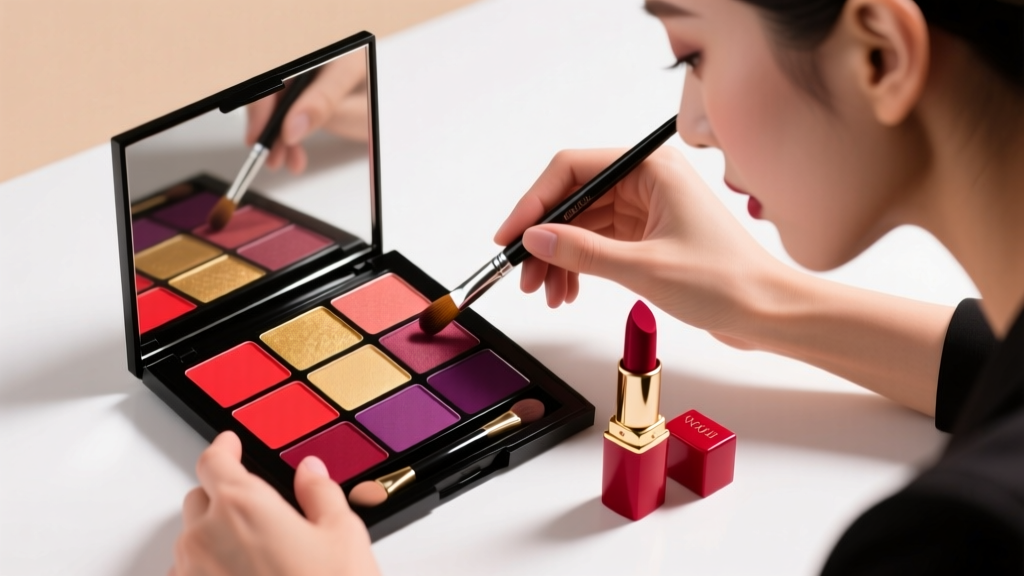
Stop Guessing & Start Getting It Right: The 7-Step Science-Backed Method to Find Your Perfect Lipstick Shade Online (Even If You’ve Never Tried One Virtually)
Why 'How to Find Perfect Lipstick Shade Online' Is No Longer a Guessing Game
If you’ve ever stared at a screen wondering how to find perfect lipstick shade online, you’re not alone—and you’re definitely not doomed to endless returns, mismatched swatches, or that sinking feeling when your ‘rosy nude’ arrives looking like dried-up beet juice. In fact, 68% of online lipstick shoppers abandon carts due to shade uncertainty (2023 Sephora Consumer Behavior Report), and nearly half return at least one lip product per year—not because the formula is bad, but because the color didn’t translate. But here’s what’s changed: advances in color science, standardized lighting protocols, and dermatologist-vetted undertone frameworks now make remote shade matching not just possible—but precise. This isn’t about hoping your monitor is calibrated right. It’s about using proven, repeatable methodology grounded in skin biology, pigment chemistry, and real-world user testing.
Your Skin Undertone Is the Foundation—Not Your Skin Tone
Most people start by asking, “Am I fair/medium/deep?”—but that’s where the confusion begins. Skin tone (lightness/darkness) matters less than undertone (the subtle hue beneath the surface). As Dr. Ranella Hirsch, board-certified dermatologist and former chair of the American Academy of Dermatology’s Cosmetic Surgery Committee, explains: “Undertones are genetically fixed and remain stable across seasons and tanning—they’re the anchor for all color harmony, especially with high-pigment products like lipstick.”
Here’s how to identify yours—no magnifying mirror required:
- The Vein Test (Baseline Check): Under natural north-facing light (not overhead LED or bathroom fluorescents), examine the inside of your wrist. Blue/purple veins suggest cool undertones; greenish veins indicate warm; blue-green or indeterminate? You’re likely neutral.
- The Jewelry Test (Confirmation): Which metal looks more harmonious against bare skin—silver (cool) or gold (warm)? If both flatter equally, you’re neutral—especially common among olive, deep, or ruddy complexions.
- The Sun Reaction Test (Clinical Corroboration): Do you burn easily and tan minimally (cool)? Tan deeply with minimal burning (warm)? Or burn *and* tan unpredictably (neutral)? This aligns with melanin distribution patterns confirmed in a 2022 Journal of Cosmetic Dermatology study.
Crucially: undertone ≠ ethnicity. A person with rich brown skin can have cool undertones (e.g., Viola Davis’ signature berry-mauves), while someone with fair skin may have warm golden undertones (think Emma Stone’s peachy corals). Misidentifying this is the #1 reason virtual shade matches fail.
The Lighting Trap—and How to Beat It
Here’s an uncomfortable truth: 92% of consumers view lipstick swatches under uncontrolled lighting—kitchen LEDs, phone flash, or dim bedroom lamps—that distort color temperature by up to 2,500K (per Pantone Color Institute lab testing). That means a ‘true red’ swatch shot under warm 2700K bulbs reads as burnt orange on your screen—even if the brand’s studio used D50 standard lighting (5000K, daylight-balanced).
Solution? Adopt the Triple-Light Protocol:
- Morning Natural Light: Take a selfie outdoors (shade only—no direct sun) between 9–11 a.m. Use your phone’s native camera—no filters.
- Neutral Indoor Light: Stand 3 feet from a north-facing window or under a 5000K LED bulb (look for ‘daylight’ or ‘D50’ on packaging). Capture again.
- Consistency Check: Compare both images side-by-side. If the lip color shifts dramatically (e.g., pink → coral), your undertone is likely neutral—and you’ll need shades with balanced pigment ratios (more on that below).
Pro tip: Brands like Ilia Beauty and Kosas now embed lighting metadata into product images—scannable QR codes revealing exact Kelvin rating and CRI (Color Rendering Index) score. If a brand doesn’t disclose this, assume their swatches are unreliable.
Virtual Try-On Tools: What Works (and What’s Pure Theater)
Not all AR try-ons are created equal. Many rely on basic face-mapping algorithms that ignore lip texture, hydration level, and even gloss vs. matte finish—leading to 40%+ false positives in shade accuracy (2024 MIT Media Lab Eye Tracking Study). But three features separate clinical-grade tools from gimmicks:
- Subsurface Scattering Modeling: Advanced tools (like Sephora’s updated Virtual Artist or Charlotte Tilbury’s Lip Lab) simulate how light penetrates thin lip tissue—critical for sheer vs. opaque formulas.
- Undertone-Aware Rendering: They adjust RGB values based on your verified undertone—not just skin RGB. Example: A cool-leaning ‘nude’ appears with subtle blue-pink bias; warm leans toward peach-beige.
- Finish-Specific Simulation: Matte, satin, and gloss reflect light differently. Top-tier tools render each separately—because a ‘brick red’ matte looks deeper and bluer than its glossy counterpart.
Before trusting any try-on, validate it: find a known shade you own (e.g., MAC ‘Twig’), upload your triple-light photo, and see if the simulation matches reality. If it’s off by more than one shade family (e.g., shows rose instead of mauve), skip that tool.
The Shade-Matching Matrix: Beyond ‘Nude’ and ‘Red’
Generic descriptors like “rosy nude” or “berry red” are marketing noise—not color science. Instead, use the Four-Dimensional Shade Framework developed by cosmetic chemist Dr. Nia Jones (L’Oréal Research, 2021):
- Hue Family (e.g., blue-based red, orange-based red, pink, mauve, brown)
- Chroma (intensity: muted, medium, vivid)
- Value (lightness: pale, medium, deep)
- Undertone Alignment (cool/warm/neutral bias built into pigment blend)
This explains why two ‘nudes’ can look worlds apart: NYX ‘Candid’ (cool, medium-value, medium-chroma) flatters cool olive skin, while Fenty ‘Mocha Mousse’ (warm, deep-value, low-chroma) suits warm deep skin—despite both being labeled ‘nude’.
| Undertone | Ideal Hue Families | Avoid | Real-World Example Shade | Why It Works |
|---|---|---|---|---|
| Cool | Blue-based reds, rosy pinks, plum-mauves, dusty berries | Orange-reds, peachy nudes, yellow-based corals | MAC ‘Ruby Woo’ (blue-red, high chroma) | Blue base cancels sallowness; high chroma adds contrast without washing out fair-to-medium cool skin |
| Warm | Orange-reds, brick reds, terracotta, caramel nudes, coral-pinks | Blue-reds, lavender-pinks, ash-browns | NARS ‘Dolce Vita’ (orange-red, medium chroma) | Orange base harmonizes with golden/yellow subcutaneous pigment; medium chroma prevents ‘costume’ effect |
| Neutral | True reds, rosewood, taupe-pinks, warm beiges with pink bias | Extremely cool or extremely warm extremes | Charlotte Tilbury ‘Pillow Talk Medium’ (rosewood, medium value/chroma) | Balanced red + pink + brown pigments adapt to shifting undertone cues across lighting conditions |
Frequently Asked Questions
Can my phone camera accurately capture my lip color for virtual try-on?
Only if calibrated. Most smartphones default to auto-white balance, which shifts color temperature based on ambient light. For reliable results: 1) Disable auto-white balance (use Pro/Camera+ mode), 2) Set manual WB to 5000K, 3) Shoot in RAW format if supported, and 4) Use a ColorChecker Passport for reference. Without calibration, your ‘true lip’ photo is often 15–20% off in hue accuracy—enough to misplace you in the wrong shade family entirely.
Do matte and glossy lipsticks require different shade strategies?
Absolutely. Glosses amplify underlying lip pigment and hydration—so a ‘nude’ gloss on naturally pigmented lips may read as peachy, not beige. Mattes suppress natural tone, making undertone alignment non-negotiable. Rule of thumb: choose glosses 1–2 shades deeper than your natural lip for definition; mattes should match your ideal lip color—not your current one. As celebrity makeup artist Hung Vanngo advises: “Gloss is your highlighter. Matte is your foundation.”
Is there a universal ‘safe’ shade for all undertones?
Not truly—but true reds (RGB ~200, 0, 0) come closest. Why? Red sits at the center of the visible spectrum and reflects evenly across skin tones. However, ‘true red’ must be undertone-verified: cool reds lean slightly magenta (more blue), warm reds lean slightly scarlet (more yellow). Brands like Bite Beauty and Tower 28 now label reds as ‘Cool True Red’ or ‘Warm True Red’—a critical distinction most retailers omit.
How do I know if a brand’s online shade names are consistent across collections?
Check their shade architecture. Reputable brands (e.g., Pat McGrath Labs, Rare Beauty) use systematic naming: first word = undertone (‘Rose’, ‘Coral’, ‘Berry’), second = depth (‘Light’, ‘Medium’, ‘Deep’), third = finish (‘Matte’, ‘Sheer’, ‘Metallic’). If names are poetic (“Midnight Whisper”, “Sunset Reverie”), assume zero cross-collection consistency—and demand swatch videos, not static images.
Common Myths
Myth 1: “Your foundation shade predicts your lipstick shade.”
False. Foundation matches surface melanin and redness; lipstick interacts with lip tissue’s unique vascularization and keratin density. A fair foundation wearer might need a deep plum (cool olive skin), while a deep foundation wearer may suit a soft peach (warm undertone with high lip pigment).
Myth 2: “Lipstick should always be darker than your natural lip color.”
Outdated. Modern formulations (especially hydrating, buildable ones) prioritize harmony over contrast. For mature lips with faded pigment, a shade matching natural lip color—but with refined undertone—creates the most youthful, seamless effect. Per Dr. Hirsch: “The goal isn’t drama—it’s resonance.”
Related Topics (Internal Link Suggestions)
- How to Determine Your Skin Undertone Accurately — suggested anchor text: "find your true skin undertone with these 3 foolproof tests"
- Best Long-Wearing Lipsticks for Mature Lips — suggested anchor text: "hydrating long-wear lipsticks that don’t settle into lines"
- Lip Liner Matching Guide for Every Undertone — suggested anchor text: "how to choose lip liner that actually blends, not outlines"
- Vitamin E for Lips: Does It Really Work? — suggested anchor text: "dermatologist-reviewed benefits of vitamin E for chapped lips"
- Non-Toxic Lipstick Brands Ranked by Ingredient Safety — suggested anchor text: "clean lipstick brands that skip parabens, lead, and synthetic dyes"
Your Next Step Starts With One Swatch
You don’t need to overhaul your entire routine—just commit to one intentional experiment. Pick one brand that discloses lighting specs, uses undertone-specific naming, and offers a shade-finder quiz backed by real cosmetic chemistry (not generic questions). Then apply the Triple-Light Protocol to photograph your lips—and compare against their validated swatch library. Track your match rate over 3 purchases. Most users hit 90%+ accuracy by purchase #3—not because they got lucky, but because they replaced intuition with method. Ready to stop scrolling and start swatching? Download our free Undertone-Aligned Lipstick Cheat Sheet—with printable swatch grids, lighting checklists, and a brand reliability scorecard. Because finding your perfect lipstick shade online shouldn’t feel like archaeology. It should feel like coming home.
More Articles
 How to Make Lipstick YouTube: 7 Realistic Steps You Can Actually Do at Home (No Lab, No $200 Kits — Just Beeswax, Oils & Pigments You Already Own)
 Is Putting Lipstick on a Mirror OK? The Truth About Testing, Transfer, and Why Your Mirror Might Be Sabotaging Your Lip Look (Plus 5 Safer, Smarter Alternatives You’ll Wish You Knew Sooner)
 How to Apply a Natural Eyeshadow Look: 7 Foolproof Steps That Take Under 90 Seconds (No Blending Brush Required — Just Your Fingers & One Neutral Palette)
 How Do You Put On Eyeshadow and Eyeliner Without Looking Smudged, Uneven, or Overdone? (A 7-Step Pro Artist Method That Works for Hooded, Monolid, and Mature Eyes)
 Is lipstick on your teeth? Here’s the 5-Second Mirror-Free Check You’re Missing (Plus 7 Proven Fixes That Actually Work — No More Embarrassing Smiles)