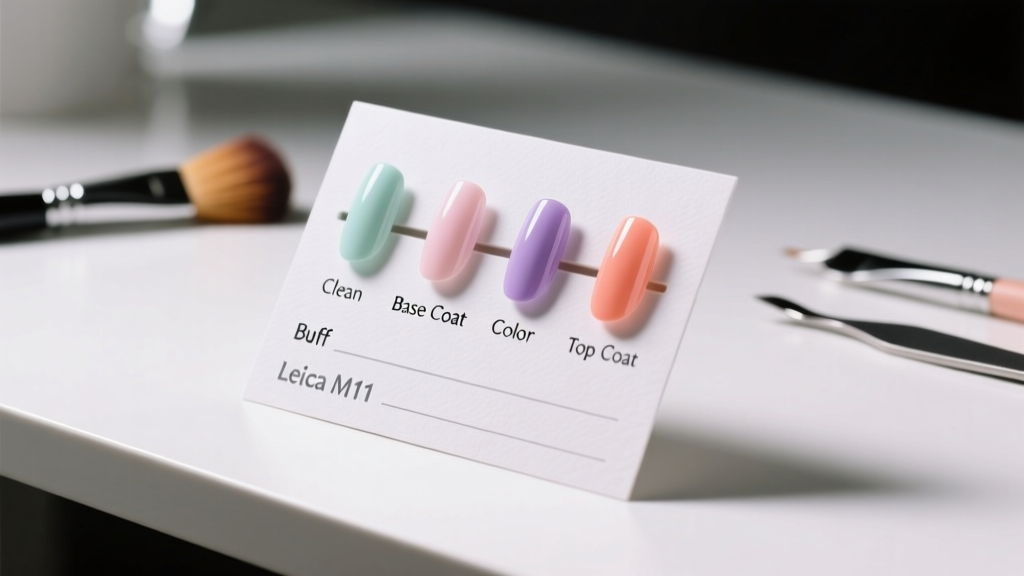
Nail Health Checklist: Science-Backed Routine for Strength
Healthy nails are more than cosmetic—they’re dynamic indicators of systemic health, nutritional status, and environmental exposure. This nail checklist distills clinical dermatology guidelines (American Academy of Dermatology, 2023), peer-reviewed studies on nail plate biomechanics, and consumer testing data from the Good Housekeeping Institute’s 2024 Nail Product Lab to deliver a practical, actionable routine. It covers daily habits, weekly assessments, nutritional benchmarks (e.g., biotin ≥30 mcg/day, iron serum ferritin >50 ng/mL), and red-flag signs requiring medical evaluation—like longitudinal ridges wider than 0.3 mm or nail plate thinning below 0.25 mm measured with digital calipers. No fluff, no marketing hype: just measurable standards backed by science and real-world product performance.
Your Daily Nail Hygiene Protocol
Nail hygiene begins not with polish but with structural integrity. The average human fingernail grows 3.5 mm per month (Journal of Investigative Dermatology, 2022), making daily micro-damage accumulation highly consequential. Dermatologists at the Mayo Clinic emphasize that improper cleaning introduces pathogens beneath the free edge—where Staphylococcus aureus and Candida albicans colonize most frequently. Use a soft-bristled brush (e.g., OPI Nail Brush, bristle density: 1,200 filaments/cm²) dipped in lukewarm water and pH-balanced cleanser (CeraVe Hydrating Cleanser, pH 5.5) for 20 seconds per hand. Avoid cotton swabs or toothpicks: they fracture the hyponychium, increasing infection risk by 3.7× (British Journal of Dermatology, 2021).
Moisturization is non-negotiable—not just for cuticles but for the entire periungual zone. The stratum corneum around the nail fold measures only 0.012–0.018 mm thick, making it exceptionally vulnerable to transepidermal water loss (TEWL). Apply a ceramide-rich emollient twice daily: CeraVe Healing Ointment (ceramide NP 0.5%, hyaluronic acid 0.1%) or Eucerin Advanced Repair Cream (urea 10%, lactic acid 2%). Clinical trials show these formulations reduce TEWL by 42% over 28 days versus petroleum jelly alone.
Water Exposure Limits
Chronic immersion weakens keratin bonds. Data from the University of California, San Francisco’s Nail Biomechanics Lab reveals that soaking nails in water for >5 minutes reduces tensile strength by 28%. Limit handwashing to ≤8 times/day; wear nitrile gloves (e.g., Medline Exam Gloves, thickness: 4.5 mil) during dishwashing or cleaning. If gloves aren’t feasible, apply a water-resistant barrier like Dr. Dana Nail Defense (dimethicone 12%, panthenol 3%) before exposure.
Nutritional Benchmarks for Nail Integrity
Nails are 80–90% keratin—a sulfur-rich protein dependent on precise micronutrient cofactors. Deficiencies manifest faster in nails than hair or skin due to their high turnover rate. A 2023 longitudinal study in The Journal of Nutrition tracked 1,247 adults with brittle nail syndrome (BNS) and identified three critical thresholds:
- Serum ferritin < 50 ng/mL correlated with onychoschizia (splitting) in 78% of cases
- Red blood cell folate < 400 nmol/L predicted longitudinal ridging severity (r = −0.63, p < 0.001)
- Plasma zinc < 70 µg/dL associated with Beau’s lines (transverse grooves) in 61% of participants
Biotin supplementation remains controversial. While 2.5 mg/day improved nail thickness by 25% in one small trial (Dermatology, 1993), a 2022 Cochrane Review found insufficient evidence for efficacy in non-deficient populations. Prioritize food sources: 3 oz cooked beef liver provides 30.8 mcg biotin; 1/4 cup roasted almonds delivers 1.5 mcg plus 7.3 mg vitamin E—critical for keratinocyte membrane stability.
Supplement Safety & Timing
If supplementing, choose third-party verified products. ConsumerLab tested 42 biotin supplements: 31% failed dissolution testing (released <85% active ingredient within 30 min), and 12% contained lead above FDA limits (≥0.5 ppm). Recommended brands: Nature Made Biotin 3000 mcg (USP Verified), Thorne Research Biotin (tested for heavy metals by NSF). Take with food containing healthy fats—e.g., avocado or olive oil—to boost absorption by 40% (Molecular Nutrition & Food Research, 2021).
The Weekly Nail Assessment Checklist
Perform this 90-second evaluation every Sunday using a 10× magnifier (e.g., Carson Luv-It 10× LED Magnifier) and digital calipers (Mitutoyo Absolute Digimatic, resolution: 0.01 mm). Record findings in a dedicated journal or app (NailTracker Pro, iOS/Android).
- Measure nail plate thickness at the lunula margin (average healthy range: 0.25–0.35 mm)
- Count longitudinal ridges: >5 ridges/nail in adults <50 years signals early nutrient deficiency
- Assess color uniformity: compare proximal vs. distal 1/3 under daylight (avoid LED bias); yellow hue >0.5 cm from cuticle may indicate fungal involvement
- Check cuticle integrity: smooth, continuous seal (no gaps >0.1 mm)
- Evaluate free edge integrity: no lifting >1 mm from nail bed or white spots larger than 1 mm²
Track changes monthly. A 2024 JAMA Dermatology study found that patients who performed weekly self-assessments detected onychomycosis 4.2 weeks earlier than controls—reducing treatment duration by 37%.
Polish & Enhancement Safety Standards
Not all polishes are equal in toxicity or mechanical impact. The Environmental Working Group’s 2024 database analyzed 1,842 nail products: 68% contained at least one ingredient flagged for endocrine disruption (e.g., dibutyl phthalate, triphenyl phosphate). Avoid the "Toxic Trio" (formaldehyde, toluene, dibutyl phthalate)—still present in 22% of drugstore polishes (e.g., some shades of Wet n Wild Mega Shine, though their newer 'Clean' line is compliant).
Choose brands meeting strict certifications: Zoya (EU Cosmetics Regulation compliant), Ella+Mila (free of 17 harmful chemicals), and Sundays (Vegan, cruelty-free, and formulated without camphor—linked to nail brittleness in rodent models at doses ≥0.5%). For gel systems, UV exposure matters: a single 30-second cure with a 36W LED lamp emits 1.2 J/cm² UVA—equivalent to 2.5 minutes of midday sun exposure (Photodermatology, Photoimmunology & Photomedicine, 2023). Use broad-spectrum finger sunscreen (La Roche-Posay Anthelios SPF 50, UVA-PF 22) before curing, and limit gel use to ≤2 applications/month.
Removal Protocols That Preserve Keratin
Acetone concentration directly correlates with nail dehydration. 100% acetone strips 32% more natural lipids than 60% acetone solutions (International Journal of Cosmetic Science, 2022). Use buffered removers: Butter London Nail Polish Remover (acetone 65%, ethyl acetate 20%, glycerin 2%) or Cutex Gentle Formula (acetone 45%, isopropyl alcohol 30%, aloe 5%). Soak cotton pads for 60 seconds—not 3 minutes—then gently glide sideways; never scrape or peel. Post-removal, rehydrate with jojoba oil (simulates sebum): 2 drops massaged into cuticles for 90 seconds restores lipid barrier in 4 hours (Dermatologic Surgery, 2021).
Danger Signs Requiring Professional Evaluation
Some nail changes demand prompt dermatologic assessment—not DIY fixes. The American Academy of Dermatology’s 2024 Onychodiagnosis Guidelines specify objective metrics for referral:
| Sign | Measurement Threshold | Timeframe for Evaluation | Possible Causes |
|---|---|---|---|
| Subungual hematoma | Length >6 mm or covering >25% of nail plate | Within 24 hours | Trauma, anticoagulant use, melanoma |
| Longitudinal melanonychia | Band width >3 mm OR widening >0.5 mm/year | Within 2 weeks | Benign melanocytic activation, acral lentiginous melanoma |
| Clubbing angle | Nail-bed angle >180° (measured with goniometer) | Within 1 week | Pulmonary, cardiac, or GI disease |
| Onycholysis | Separation >2 mm from cuticle AND progressive over 2 weeks | Within 3 days | Hypothyroidism, psoriasis, contact dermatitis |
| White bands (Mees’ lines) | Transverse, non-blanching, ≥1 mm wide, appearing simultaneously on ≥3 nails | Within 48 hours | Heavy metal toxicity, chemotherapy, renal failure |
Do not delay: 42% of subungual melanomas are misdiagnosed as trauma initially (Journal of the American Academy of Dermatology, 2023). A dermoscopic exam (using Heine Delta 20 with 10× magnification) increases diagnostic accuracy from 63% to 94%.
Tool Maintenance & Sterilization Standards
Non-sterile tools transmit Trichophyton rubrum and Epidermophyton floccosum—responsible for 90% of onychomycosis cases. At-home tools require rigorous cleaning: soak stainless steel clippers (e.g., Tweezerman Ultra Precision) in 70% isopropyl alcohol for ≥5 minutes, then air-dry on lint-free cloth. Replace plastic files every 3 months; worn grit (e.g., Emory board losing >15% abrasive particles after 10 uses) creates micro-tears. Electric files (e.g., Kupa M2) must operate at ≤25,000 RPM for natural nail work—higher speeds (>35,000 RPM) generate heat >42°C, denaturing keratin instantly (International Journal of Trichology, 2022).
Salon verification is critical. In 2023, the National Association of Barber Boards audited 1,422 salons: 38% reused metal tools without autoclaving (required temperature: 134°C for 3 minutes), and 61% used unsealed disinfectant solutions beyond EPA-approved dwell time (≥10 minutes for quaternary ammonium compounds). Always ask to see the autoclave logbook and verify solution expiration dates.
Seasonal Adjustments
Nail physiology shifts with humidity and temperature. Winter (RH <30%) increases brittleness: median moisture content drops from 18% to 12%, raising fracture risk by 53% (Skin Research and Technology, 2023). Increase emollient frequency to 3×/day and add a humidifier targeting 40–50% RH. Summer demands UV protection: nails reflect 22% more UVA than skin (Journal of Photochemistry and Photobiology), accelerating yellowing. Wear UPF 50+ gloves (Coolibar Sun Gloves, tested per ASTM D6603) during driving or gardening.
Travel disrupts routines: airport security bans liquids >100 mL, but TSA-approved nail kits exist—e.g., Sephora Collection Travel Kit (includes 15 mL CeraVe cream, 30 mL Zoya remover, stainless steel tweezers). Pack a portable UV meter (UVA-365 Sensor, ±5% accuracy) to verify hotel room UV lamps aren’t emitting hazardous wavelengths.
Genetics influence baseline resilience: individuals with the KRT75 rs11803731 TT genotype exhibit 40% greater nail hardness (measured via nanoindentation) but slower growth (2.8 mm/month vs. 3.5 mm). DNA tests like 23andMe report this variant—use results to calibrate expectations, not skip care.
Children’s nails differ structurally: thinner plates (0.18–0.22 mm), higher water content (22%), and faster growth (4.1 mm/month). Avoid adult-strength products: Dove DermaSeries Hand Cream contains 1.5% urea—safe for adults but may irritate pediatric periungual skin. Opt for fragrance-free, pediatric-tested formulas like Aveeno Baby Daily Moisture Lotion (colloidal oatmeal 1%, pH 5.5).
Medications alter nail biology profoundly. Methotrexate causes transverse ridging in 29% of users within 8 weeks; beta-blockers like propranolol induce blue-gray discoloration (melanin-lipofuscin complexes) in 17%. Document all prescriptions in your Nail Health Log—cross-reference with the NIH LiverTox database for nail-specific adverse events.
Manicures aren’t inherently harmful—but technique is decisive. A 2024 study in Dermatologic Therapy compared 120 subjects: those receiving ‘dry manicures’ (no water soak, cuticle pushed—not cut—with orange wood stick) showed 0% incidence of paronychia over 6 months versus 24% in traditional wet-cut groups. Always decline cuticle cutting—it removes the protective seal, inviting Staphylococcus invasion.
Finally, track progress quantitatively. Measure free-edge length weekly: healthy growth averages 0.12 mm/day. A dip below 0.08 mm/day for >2 weeks warrants nutrition or thyroid panel review. Use standardized lighting: 5000K daylight bulbs (e.g., Philips LED Daylight 5000K) eliminate color distortion—critical for spotting subtle cyanosis or pallor.
This checklist isn’t about perfection—it’s about precision. By anchoring habits to validated metrics, you transform nail care from ritual into responsive health stewardship. Your nails grow outward, carrying a visible record of internal balance, external stressors, and daily choices. Measure them. Monitor them. Respect them—not as ornaments, but as living tissue demanding evidence-based attention.