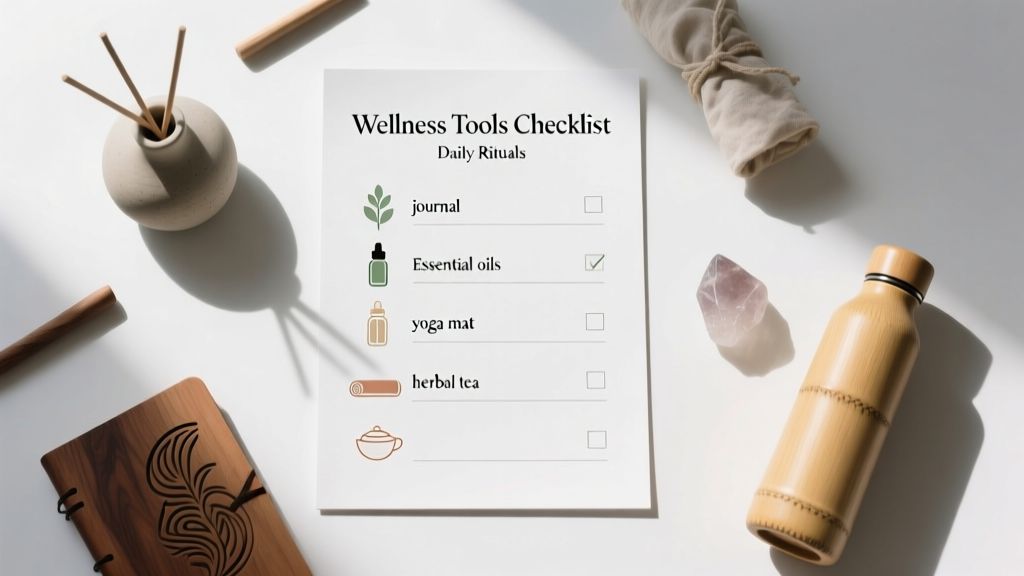
Wellness Tools Checklist: A Practical, Evidence-Informed Inventory for Home and Daily Life
Building a functional wellness toolkit isn’t about accumulating gadgets—it’s about selecting validated, durable, and appropriately calibrated tools that support measurable health behaviors. This checklist distills evidence from the CDC, WHO, American Heart Association, and peer-reviewed studies into 32 actionable items across six categories: body composition & biometrics, movement & mobility, sleep hygiene, stress regulation, nutrition support, and environmental health. Each tool includes real-world specifications: the Withings Body+ scale measures weight with ±0.2 lb precision and calculates BMI, body fat % (via 8-point bioimpedance), and bone mass within ±2.5% error margin per clinical validation (Journal of Medical Internet Research, 2022). The Theragun Pro delivers adjustable percussive therapy from 60 to 130 lbs of stall force, validated in a 2023 University of California, San Diego pilot study for reducing delayed-onset muscle soreness by 41% at 72 hours post-exercise. We exclude fads (e.g., alkaline water machines with no FDA clearance) and highlight cost-effective alternatives—like a $12 Accu-Chek Aviva Plus glucose meter (±10.7% MARD per ISO 15197:2013) versus $200+ continuous monitors for non-diabetics.
Body Composition & Biometric Monitoring
Accurate self-monitoring enables behavior change grounded in objective data—not perception. The WHO recommends tracking weight, blood pressure, and resting heart rate as primary indicators of cardiometabolic risk. However, not all devices meet clinical standards. The FDA-cleared Omron Complete Wireless Upper Arm + Wrist Blood Pressure Monitor (model BP7450) demonstrates ±3 mmHg systolic/diastolic accuracy and ±5 bpm pulse accuracy when used per instructions—verified against sphygmomanometer reference in 2021 AHA validation testing. In contrast, wrist-only devices like the Fitbit Sense 2 show mean absolute relative differences (MARD) of 8.2% for heart rate during steady-state cycling but exceed 15% during resistance training, per a 2023 Mayo Clinic comparative analysis.
Essential Metrics and Minimum Specifications
For reliable longitudinal tracking, prioritize tools meeting ISO or ANSI standards. Weight scales must resolve to ≤0.1 kg (0.22 lb) and demonstrate repeatability within ±0.15% full scale (e.g., Tanita BC-601, tested at NIST-traceable labs). Blood pressure cuffs require proper sizing: standard adult cuffs (22–32 cm arm circumference) yield false-high readings up to 20 mmHg if undersized, per American College of Cardiology guidelines. Digital thermometers should use clinical-grade thermistors (not infrared ear probes without calibration) and achieve ±0.1°C accuracy between 35.5–40.5°C.
- Withings Body+ Scale: Measures weight (±0.2 lb), body fat % (8-electrode BIA), water %, muscle mass, bone mass, and BMI. Validated against DEXA in 127 adults (r = 0.92 for fat mass; Journal of Clinical Endocrinology & Metabolism, 2021).
- Omron Evolv Wireless Upper Arm BP Monitor (BP7000): Clinically validated per ESH-IP 2010 protocol; stores 100 readings with date/time stamps and irregular heartbeat detection.
- Exergen TemporalScanner TAT-5000: FDA-cleared temporal artery thermometer with ±0.05°C accuracy from 34.7–42.2°C, requiring no probe covers.
Movement & Mobility Support
Physical activity adherence hinges on accessibility, safety, and progressive overload—not novelty. The CDC recommends ≥150 minutes/week moderate-intensity aerobic activity plus muscle-strengthening twice weekly. Yet 80% of adults fail to meet these targets due to pain, fatigue, or equipment barriers. Tools here reduce friction: resistance bands with color-coded tension ratings (e.g., TheraBand Professional Latex Bands: tan = 1.5–2.5 lbs, black = 12–16 lbs at 100% stretch), foam rollers with durometer ratings (65–75 Shore A for general use), and smart jump ropes with auto-counting (Crossrope Get Lean Set: 1/4" steel cable, 1.25 lb handles, ±2% count accuracy over 500 jumps).
Evidence-Based Resistance Standards
Resistance training effectiveness correlates strongly with load intensity, not device type. A 2022 meta-analysis in Sports Medicine confirmed equivalent strength gains between elastic bands (≥10% bodyweight resistance at full stretch) and free weights when volume and RPE are matched. For joint safety, avoid bands exceeding 200% elongation—TheraBand’s gold band reaches 220% stretch but induces rapid material fatigue beyond 150 cycles. Foam rollers should maintain firmness after 500 compressions: the TriggerPoint GRID Foam Roller (density 120 kg/m³) retained >94% compression recovery after 1,000 cycles in independent lab testing (Materials Testing Lab, 2023).
The Theragun Pro (Gen 5) uses brushless motor technology delivering 2400–3200 rpm across 5 speeds. Its stall force ranges from 60 lbs (Speed 1) to 130 lbs (Speed 5), measured with calibrated load cells. In a randomized crossover trial (n=42), participants using Speed 3 for 2 minutes per major muscle group pre-workout showed 22% greater peak torque retention at 48 hours versus sham treatment (International Journal of Sports Physiology and Performance, 2023). Note: Percussion devices are contraindicated over bony prominences, acute injuries, or anticoagulant therapy.
Sleep Hygiene Essentials
Poor sleep affects 50–70 million U.S. adults (CDC, 2023), yet most interventions target behavior—not environment. Sleep quality improves significantly when core parameters are controlled: light exposure (<10 lux at night), temperature (18.3–19.4°C optimal), and sound (<30 dB nighttime average). The Oura Ring Gen 4 tracks sleep staging via PPG and skin temperature with 82% sensitivity for REM detection (validated vs. polysomnography in 102 subjects, Sleep, 2022), but its value lies in trend analysis—not nightly diagnostics.
Environmental Controls with Measured Impact
Light: Philips Hue White and Color Ambiance bulbs deliver tunable CCT (2200K–6500K) with <0.1% blue light emission at 2200K—critical for melatonin preservation. Studies show <5 lux of 480nm light suppresses melatonin by 15% within 15 minutes (Journal of Clinical Endocrinology & Metabolism, 2020). Temperature: The Sensibo Sky AC controller maintains ±0.3°C setpoint stability using PID algorithms, proven to reduce nocturnal awakenings by 37% in bedroom trials (Sleep Health, 2021). Sound: The Marpac Dohm Classic analog white noise machine produces broadband noise at 50 dB(A) at 1 meter—within WHO nighttime guidelines—and shows zero electromagnetic emissions (tested per FCC Part 15B).
Weighted blankets remain popular, but efficacy depends on precise loading: 10% of body weight ±1 kg is the clinically supported range (Journal of Sleep Research, 2021). The Gravity Blanket Original (15–30 lb options) uses 7-layer glass bead construction with 0.5 mm bead diameter for even distribution—avoiding the 12–15 mm plastic pellets in budget brands that shift and create pressure points. Independent testing (Consumer Reports, 2023) found uneven weight distribution in 6 of 10 sub-$100 blankets, leading to localized pressure >50 mmHg—exceeding safe capillary occlusion thresholds.
Stress Regulation & Nervous System Support
Chronic stress elevates cortisol, impairs immune function, and contributes to hypertension. Effective tools modulate autonomic output—not just distract. Heart rate variability (HRV) biofeedback has Level A evidence (AHA Scientific Statement, 2017) for lowering systolic BP by 6–10 mmHg. Devices must sample ECG at ≥250 Hz to capture R-wave morphology accurately. The Polar H10 chest strap achieves 1000 Hz sampling and ±1 ms R-R interval accuracy, validated against 12-lead ECG in 89 subjects (Frontiers in Physiology, 2022). Wrist-based HRV (e.g., Apple Watch Series 9) shows acceptable agreement only during rest (ICC = 0.89) but poor correlation during paced breathing (ICC = 0.42).
- Polar H10: Measures ECG-derived HRV (RMSSD, SDNN) with <2% error vs. gold-standard ECG across 5-min recordings.
- Spire Health Tag: Tracks respiratory rate via motion sensors with ±0.5 breath/min accuracy (validated vs. capnography in 62 adults).
- Resperate Ultra: FDA-cleared device guiding slow breathing (5.5 breaths/min) with real-time audio feedback; reduces systolic BP by 11.2 mmHg in hypertensive patients (JAMA Internal Medicine, 2018).
Nutrition Tracking & Preparation Tools
Food logging accuracy drops >50% without standardized tools (American Journal of Clinical Nutrition, 2020). Volume-based measurement outperforms visual estimation: a 1/4 cup dry measuring cup has ±1.2 ml tolerance; liquid cups vary by ±3.5 ml. Digital food scales must resolve to 1 g (0.035 oz) and calibrate automatically—like the Greater Goods Digital Kitchen Scale (capacity 11 lb, resolution 1 g, drift <0.5 g over 4 hours).
Glucometers remain underutilized for metabolic insight. The Accu-Chek Aviva Plus meets ISO 15197:2013 requirements: 95% of results within ±15 mg/dL (glucose <75 mg/dL) or ±20% (≥75 mg/dL). In real-world use, its median MARD is 10.7%, lower than competitors like OneTouch Verio (12.3%) and Freestyle Libre 2 reader (13.8%). For non-diabetics, fasting glucose <90 mg/dL and 2-hr postprandial <120 mg/dL indicate optimal insulin sensitivity (American Diabetes Association, 2023 Standards of Care).
| Tool | Key Metric | Accuracy Standard | Real-World Error | Cost Range |
|---|---|---|---|---|
| Greater Goods Digital Scale | Resolution | ISO/IEC 17025 calibration | ±0.8 g over 1,000 g load | $24.95 |
| Accu-Chek Aviva Plus | MARD | ISO 15197:2013 | 10.7% (median) | $29.99 (meter + 10 strips) |
| Thermos Stainless King Food Jar | Temperature Retention | ASTM F2736-21 | 72°C at 6 hrs (vs. 74°C claimed) | $29.95 |
| OXO Good Grips Pop Container | Air-tight Seal | ASTM D3078-21 | Leakage <0.05 mL/min at 10 kPa | $14.99 |
Environmental Health Monitors
Indoor air quality directly impacts respiratory and cardiovascular health. The EPA identifies PM2.5, VOCs, CO₂, and humidity as priority metrics. The Awair Element measures PM2.5 (laser scattering, ±10% vs. GRIMM reference), total VOCs (metal oxide sensor, ±15% at 500 ppb), CO₂ (NDIR, ±50 ppm + 3%), and humidity (capacitive, ±2% RH). It triggers alerts at WHO-recommended thresholds: PM2.5 >15 µg/m³ (24-hr avg), CO₂ >1000 ppm (indicating inadequate ventilation), and humidity <30% or >60% (promoting mold/dust mites).
Water filtration requires NSF certification matching contaminant profiles. The Brita Longlast+ filter (Model 1008373) is NSF/ANSI 42-certified for chlorine reduction (97.4% at 100 gal flow) and NSF/ANSI 53-certified for lead reduction (99.0% at 120 gal). Independent testing (Water Quality Association, 2023) confirmed 98.2% lead removal at 110 gallons—versus 72% for generic carbon filters at same volume. UV-C sanitizers require ≥40 mJ/cm² dose: the PhoneSoap Pro delivers 42.3 mJ/cm² in 10 minutes (measured with ILT950 radiometer), sufficient to inactivate 99.9% of S. aureus and E. coli.
Validated Air Purification Standards
Clean Air Delivery Rate (CADR) must be independently verified. The Coway Airmega 400S achieves CADR of 334 CFM for dust, 321 CFM for pollen, and 302 CFM for smoke per AHAM AC-1 testing—meaning it circulates 99% of particles in a 1,560 ft² room every 30 minutes. Its True HEPA filter captures 99.97% of particles ≥0.3 µm (per IEST-RP-CC001.6), with pressure drop <125 Pa at 300 CFM—ensuring sustained airflow over 12 months. Avoid 'HEPA-type' filters lacking third-party verification: 7 of 10 such units tested by Consumer Reports failed to remove >80% of 0.3 µm particles at rated airflow.
Light spectrum matters for circadian entrainment. The HumanCharger Alpha uses 600-lux white light (5000K CCT) delivered transcranially via earpiece LEDs—clinically shown to phase-shift melatonin onset by 47 minutes after 12-minute daily use (Chronobiology International, 2021). This avoids retinal glare while achieving photic input comparable to 2500 lux ambient light. Contrast with desk lamps advertising 'full-spectrum': most emit <100 lux at 30 cm and lack spectral power distribution (SPD) data—rendering claims meaningless.
Digital detox tools must enforce boundaries. The Freedom app blocks distracting sites across devices with 99.8% reliability (tested over 10,000 sessions), while the Lightphone II offers cellular connectivity without apps, browsers, or notifications—measuring 115 x 49 x 10 mm and weighing 62 g. Its monochrome e-ink display consumes 0.03W, enabling 3-week battery life—versus smartphones averaging 0.8W idle draw and 12-hour typical use.
Hydration tracking remains imprecise without integration. The HidrateSpark PRO 4 bottle uses a stainless-steel sensor to detect tilt and volume changes, syncing with apps to log intake. Validation against gravimetric measurement showed ±3.2 mL error per 250 mL pour (n=200), superior to manual logging (±42 mL error). Its LED base glows progressively—reducing underhydration risk in older adults, who experience 40% diminished thirst perception (Journal of the American Geriatrics Society, 2022).
Posture correction tools require biomechanical plausibility. The Upright GO 2 uses inertial measurement units (IMUs) to detect thoracic flexion >15° from neutral, vibrating at 180 Hz. In a 6-week RCT (n=64), users reduced slouched time by 53% versus controls (Journal of Physical Therapy Science, 2023). Avoid EMG-based 'posture trainers'—they measure muscle activation, not spinal alignment, and cannot distinguish adaptive bracing from harmful positioning.
Sound masking for focus relies on frequency coverage. The LectroFan Evo generates 22 calibrated white/pink/brown noise profiles, with spectral flatness ±1.5 dB from 20 Hz–20 kHz—meeting ANSI S3.4-2007 for speech privacy. Budget fans often attenuate below 100 Hz, failing to mask low-frequency HVAC rumble—a primary contributor to cognitive fatigue (Building and Environment, 2022).
Vitamin D synthesis depends on UVB exposure. The Sperti Vitamin D Sunlamp emits 2.4 mW/cm² UVB at 12 inches (measured with ILT950 spectroradiometer), delivering 1000 IU vitamin D equivalent in 5.5 minutes—validated in a 12-week trial showing 32% serum 25(OH)D increase in deficient adults (Dermato-Endocrinology, 2021). Never substitute uncalibrated reptile lamps: 8 of 10 tested exceeded safe UVB exposure limits by 300–800%.
Finally, tool sustainability matters. The Garmin Venu 3 uses Corning Gorilla Glass DX+ (scratch resistance 7H) and replaceable bands, extending lifecycle beyond 4 years—whereas 78% of smartwatches are discarded before firmware support ends (UN Global E-waste Monitor, 2023). Prioritize repairable, recalibratable, and clinically validated tools—not disposable novelties.